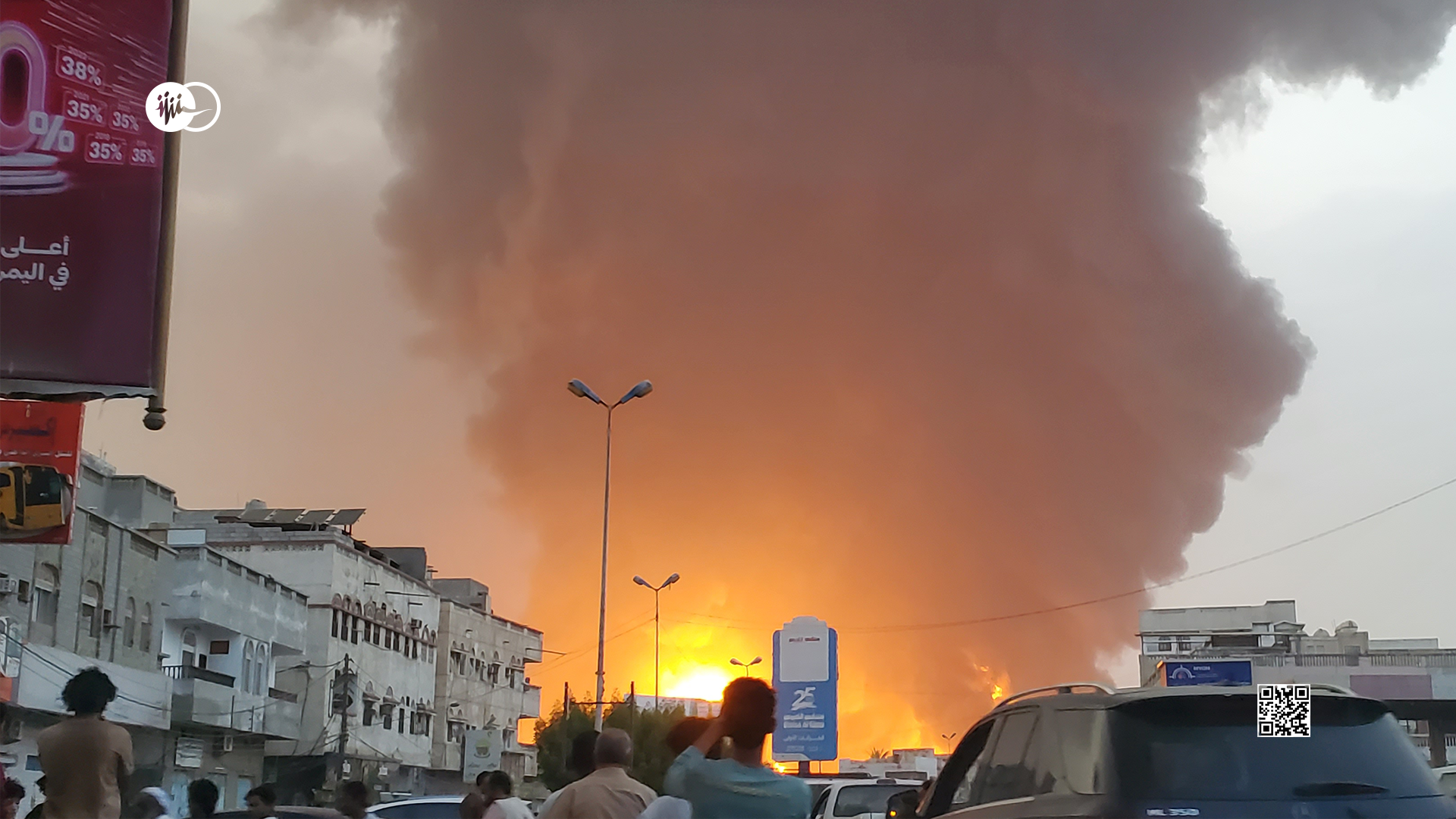
Destruction of Civilian Infrastructure and Worsening Suffering for Millions of Civilians
Mwatana for Human Rights said in a statement today, marking one year since the start of Israeli airstrikes in Yemen on July 20, 2024, that the repeated Israeli attacks, which primarily targeted civilian infrastructure and vital facilities, constitute war crimes and flagrant violations of the rules of international humanitarian law. These attacks have deepened the suffering of millions of civilians in a country already grappling with one of the world’s worst humanitarian crises for over a decade. Israel has claimed that its operations in Yemen are in response to attacks by the Ansar Allah (Houthi) group targeting Israel-linked shipping in the Red Sea and sites within Israel—including missile strikes on Ben Gurion Airport—which the group says it is launching in solidarity with the Palestinian people in the Gaza Strip.
Mwatana added that, through its field team, it has verified 17 Israeli airstrikes that targeted civilian objects, facilities, and residential neighborhoods across several Yemeni governorates under the control of the Ansar Allah (Houthi) group. These attacks resulted in at least 141 civilian casualties, including 34 fatalities—among them 4 children—and 107 injuries, including 3 children and one woman, from the beginning of Israel’s military operations in Yemen on July 20, 2024, through July 2025.
Mwatana noted that its field teams conducted no fewer than 41 field interviews with survivors, relatives of victims, eyewitnesses, first responders, and local residents. They also visited the targeted sites and documented the resulting damage as part of the organization's ongoing efforts to monitor and document violations against civilians and civilian objects.
Mwatana pointed out that Israeli airstrikes were concentrated in the governorates of Al Hudaydah, Sana’a, and the Capital Secretariat, all under the control of the Ansar Allah (Houthi) group. The strikes repeatedly targeted several civilian industrial and service facilities, including the ports of Al Hudaydah, Ras Isa (oil terminal), and Al Salif, Sana’a International Airport, the Ras Katnib central power station, the Haziz power station in Sana’a, and the Bajil cement factory in Al Hudaydah Governorate. One of the airstrikes also hit a residential neighborhood in Al-Hali District, Al Hudaydah Governorate. In addition to civilian casualties, these attacks caused extensive damage to the infrastructure of the targeted facilities and surrounding areas, disrupting critical services essential to the survival of the civilian population.
Mwatana stated that the repeated targeting of such vital facilities constitutes a violation of the principles of international humanitarian law, foremost among them the principle of distinction enshrined in Article 48 of the Additional Protocol I to the 1977 Geneva Conventions, which obligates parties to a conflict to distinguish at all times between civilians and combatants, and between civilian objects and military objectives. The bombing of such facilities, which are indispensable to civilians for meeting their basic needs, also constitutes a grave breach of Article 54 of the same Protocol, which prohibits attacks on “objects indispensable to the survival of the civilian population,” including food, water, and energy sources. Such acts may amount to war crimes under Article 8 of the Rome Statute of the International Criminal Court.
Abdulrasheed Al-Faqih, Vice President of Mwatana for Human Rights, stated:
"Israel deliberately responded to the Ansar Allah (Houthi) group’s attacks on Israeli interests by destroying civilian infrastructure that serves millions of civilians, showing utter disregard for the consequences. Its willingness to commit such violations in Yemen has been emboldened by the international community’s failure to act to stop the widespread violations it has committed in Gaza and beyond. Unless the international community takes steps to hold Israel accountable for all its violations, it will not only encourage Israel to commit further abuses, but also embolden new actors to perpetrate horrific violations, ignite wars, and fuel cycles of violence and terrorism across the globe amid a prevailing climate of impunity. This is a catastrophic outcome that can still be avoided through responsible action grounded in the principles of international law."
Examples of Israeli Airstrikes in Yemen
Targeting of Al Hudaydah Port in Al Mina District of Al Hudaydah Governorate
On Saturday, July 20, 2024, at approximately 5:50 p.m., Israeli fighter jets launched five airstrikes on Al Hudaydah Port in Al Mina District, Al Hudaydah Governorate. Two of the strikes hit cranes located at Pier 7, while three others targeted fuel storage tanks. The attack killed nine civilians working at the port facilities and injured at least 87 others, including two children. The strikes also caused extensive destruction to the oil facility at the port, as the fuel tanks containing petrol, diesel, and mazut caught fire. Two of the main cranes used for loading and unloading goods were destroyed and rendered completely inoperable.
One survivor (male, 39 years old) told Mwatana:
"I was standing next to one of the fuel tanks at the port, going about my usual work, when suddenly a missile struck one of the cranes inside the port. The explosion was incredibly violent—I was terrified. In those moments, I thought of my family and my daughter and asked myself: will I return to them? Or will another strike end my life? Images of the war in Gaza flashed through my mind, when warplanes were dropping missiles among civilians. Then I started running toward the port exit gate as fast as I could."
He continued:
"While I was running, another airstrike hit a fuel tank close to where I had been. I jumped and fell to the ground, then started crawling on my stomach. I couldn’t lift my head because of the unbearable heat and flames. People were running in every direction. It was total panic."
He added:
"At the time, I didn’t even realize what had happened to me—I just wanted to survive. Later, I found out I had been hit by shrapnel in my thigh and had bled heavily. I also suffered second-degree burns. After I got out of the port, I first went home to reassure my family that I was still alive, and then I went to the hospital for treatment."
On Sunday, September 29, 2024, at approximately 5:50 p.m., Israeli fighter jets launched two airstrikes targeting the power station at Al Hudaydah Port, almost completely destroying it and rendering it inoperable. The attack killed one employee at the station, whose body was torn to pieces while he was performing his duties. The strike also caused a complete power outage at the port and throughout Al Hudaydah city for more than four days.
On Thursday, December 19, 2024, at approximately 4:15 p.m., Israeli fighter jets again targeted Al Hudaydah Port with multiple airstrikes, resulting in the complete destruction of three tugboats (cranes used for lifting and moving cargo and pushing ships), and partial destruction of a fourth. These strikes disrupted the transport of food and humanitarian aid, delaying its delivery to civilian beneficiaries. One port worker sustained serious injuries as a result.
On Monday, May 5, 2025, at approximately 7:30 p.m., Israeli warplanes launched over seven airstrikes on Al Hudaydah Port—the fourth attack on the port. The strikes targeted three piers within the port and destroyed two tugboats (vessels used to move and maneuver ships to and from the port), severely disrupting cargo transport and ship movements in the targeted area.
On Sunday, July 6, 2025, at around 11:30 p.m., Israeli fighter jets carried out approximately fifteen airstrikes on the vital Al Hudaydah Port—marking the eighth such attack within a year. The strikes targeted container and grain terminals at the port, located in northwest Yemen. Around ten additional airstrikes hit Ras Isa Port, targeting fuel discharge terminals for gasoline and diesel, while approximately seven airstrikes hit Al Salif Port, striking its piers. Around six airstrikes also targeted the Al Salif power station, damaging generation units and boilers.
Al Hudaydah Port is the only lifeline for millions of people living in areas of Yemen under the control of the Ansar Allah (Houthi) group. More than 80% of Yemen’s humanitarian aid, commercial imports, and essential goods—including food, fuel, and medical supplies—enter through Al Hudaydah Port. Over 28 million Yemenis rely on these supplies for survival. For nearly a decade of conflict, shipments arriving through Al Hudaydah have been subject to thorough inspection and monitoring by the United Nations Verification and Inspection Mechanism (UNVIM).
Targeting of Ras Isa Oil Terminal, Al Salif District, Al Hudaydah Governorate
On Sunday, September 29, 2024, at approximately 5:00 p.m., Israeli warplanes launched four airstrikes targeting fuel storage tanks at the Ras Isa Oil Terminal, located in Al Salif District, Al Hudaydah Governorate. The strikes resulted in the destruction of four fuel tanks (diesel and petrol) and injured four firefighters working at the port.
One survivor (male, 34 years old) told Mwatana:
"When the Ras Isa Oil Terminal was bombed, I and a group of my colleagues—all of us working in the fire unit—were at the site in the fire truck performing our duties. One of the missiles hit a fuel tank very close to us—no more than 20 meters away. The explosion was extremely intense."
He added:
"The fire truck driver tried to speed forward to escape, but another missile landed directly in front of us. I suffered a dislocated shoulder, and one of my colleagues was also injured. We had no choice but to jump into the sea. We swam a long distance to escape the bombing. I could swim with only one arm—the other I couldn’t move at all. Two other technical workers were hit by shrapnel in various parts of their bodies."
At dawn on Thursday, December 19, 2024, around 4:15 a.m., Israeli warplanes again targeted the Ras Isa Terminal in a series of airstrikes, completely destroying one tugboat. Two workers aboard the tugboat were killed, and two others were injured. The injured workers jumped into the sea during the bombing and managed to swim ashore, where they were later taken to a hospital in Al Hudaydah for treatment.
On Thursday, December 26, 2024, at approximately 5:20 p.m., Israeli warplanes launched another airstrike on the Ras Isa Oil Terminal—the third such attack—targeting one of the tugboats at the port. The strike completely destroyed the vessel, killed four workers who were on board, and injured two others with varying degrees of severity. The bombing also led to a halt in vessel entry and exit operations at the terminal, disrupting cargo unloading and directly affecting the port’s operational capacity.
On Sunday, July 6, 2025, at around 11:30 p.m., Israeli fighter jets again launched approximately ten airstrikes on Ras Isa Port. The strikes focused on the fuel discharge terminals (for gasoline and diesel) and caused various degrees of damage.
Targeting of Al Salif Port, Al Salif District, Al Hudaydah Governorate
On the morning of Thursday, December 19, 2024, Israeli fighter jets carried out airstrikes targeting Al Salif Port, located in Al Salif District, Al Hudaydah Governorate. The strikes hit one of the tugboats docked at the port, resulting in the death of seven workers who were on board.
The brother of one of the victims (43 years old) described to Mwatana the moment he first learned of the incident, saying:
“I received a call on Thursday morning from my nephew, which was unusual. He asked me: ‘Where are you? When will you be home from work?’ I asked him why, and he said: ‘My dad has died!’ When I heard those words, it felt like the world went dark. I couldn’t process the news—I was in complete shock. Even my coworkers began offering their condolences, but I wasn’t able to absorb their words.”
He continued:
“I contacted one of my brother’s colleagues and asked him what had happened. He told me that my brother had been on the tugboat with his coworkers, and when the airstrike hit, some of them jumped into the sea. He said my brother was asleep at the time of the attack and likely couldn’t escape. I couldn’t bear the shock—I immediately fainted.”
The body of the victim, along with several of his colleagues, was recovered from the sea two days after the attack. They were buried on Saturday, December 21, 2024.
The victim’s brother concluded, speaking through deep sorrow:
“My brother worked hard to support his family. He wasn’t a criminal or an aggressor—he was peaceful and well-loved. He never harmed anyone in his life. Every time I think of him, I break down in tears. A brother is irreplaceable, and to us, he wasn’t just a brother—he was a father figure and our main support.”
On Sunday, July 6, 2025, at approximately 11:30 p.m., Israeli fighter jets again launched around seven airstrikes on Al Salif Port, focusing on the port’s piers and causing varying degrees of damage.
Mwatana noted that Al Hudaydah Port, along with Al Salif and Ras Isa ports, are key entry points for goods and essential supplies into areas of Yemen under the control of the Ansar Allah (Houthi) group. These include vital commodities needed for the survival of millions of civilians in those regions. The organization stressed that the repeated targeting of these critical facilities will severely and directly impact the ability of these ports to receive and offload shipments of essential goods, thereby affecting millions of civilians’ access to food, medicine, fuel, and other necessities.
Targeting of Sana’a International Airport, Bani Al-Harith District, Sana’a Governorate
On Thursday, December 26, 2024, at approximately 5:00 p.m., Israeli fighter jets carried out seven airstrikes on Sana’a International Airport. The strikes targeted one of the air traffic control towers, the departure hall, and several other locations within the airport. The bombing coincided with the arrival of a flight from the Jordanian capital, Amman, just minutes before landing, posing a grave threat to the lives of passengers and flight crews.
The airstrikes caused partial damage to the control tower and the departure hall, as well as damage to other vital components and infrastructure of the airport. At least 20 people—airport employees and civilians waiting to receive passengers from the arriving flight—were either killed or injured.
An eyewitness (male, 50 years old), who was at Sana’a International Airport during the strikes, told Mwatana:
"I was at the airport waiting for my daughter’s arrival on a flight from Jordan. She had been living in the U.S. for ten years, and we had come to welcome her. I was in the parking lot when I heard the first explosion, then the second, followed by five more strikes in quick succession, with about five to ten minutes between each. I saw the control tower being blown apart right before our eyes."
He added:
"I quickly moved my family away from the parking lot to a safer spot because one of the cars had its fuel tank explode from the impact of the blasts, and I feared the fire would spread. Suddenly, I felt intense pain in my right arm—I had been hit by shrapnel."
He concluded:
"After my daughter arrived, I took her and went straight to the hospital. I had to undergo three surgeries to remove the shrapnel and stop the bleeding. Those were harsh moments—where the joy of reunion was mixed with the tears of fear and pain."
Israeli warplanes continued to target Sana’a International Airport with a series of airstrikes throughout the year, resulting in the widespread destruction of airport facilities and the complete destruction of civilian aircraft stationed on the tarmac. The attacks rendered the airport entirely inoperable, halting all civilian and humanitarian flights, and cutting off one of the most vital travel arteries—particularly for Yemenis who rely on the airport to travel abroad for urgent medical treatment.
On Tuesday, May 6, 2025, Israeli airstrikes destroyed key facilities at Sana’a International Airport, along with the civilian aircraft present on-site. Only one civilian aircraft, which happened to be at Queen Alia International Airport in the Jordanian capital, Amman, survived. On Wednesday, May 28, 2025, Israeli fighter jets destroyed the last remaining civilian aircraft just minutes after it landed at Sana’a International Airport. These attacks on the airport were part of a broader series of Israeli strikes targeting civilian infrastructure—ports, power stations, and factories—in Sana’a, Al Hudaydah, ‘Amran, and Taiz, in retaliation for attacks by the Ansar Allah (Houthi) group on Israeli targets in the Red Sea and within Israel, including missile strikes on Ben Gurion Airport, which the group launched in solidarity with the Palestinian people in the Gaza Strip.
Throughout the years of war, Sana’a International Airport has remained the only gateway for flights operated by UN agencies and humanitarian organizations in and out of the Yemeni capital. It was also the only partially operational airport available to millions of Yemenis living in areas under the control of the Ansar Allah (Houthi) group—home to approximately 70% of the country’s population—who rely on the airport as a vital lifeline to the outside world, especially patients in urgent need of medical care abroad.
Sana’a International Airport was partially reopened on May 17, 2023, under a UN-brokered agreement, allowing a limited number of Yemenia Airways flights between Sana’a and Amman. Prior to that, the airport had remained closed to commercial flights for nearly seven years, since August 9, 2016, due to restrictions imposed by the Saudi/UAE-led coalition.
Targeting of Ras Katnib Power Station, Al Salif District, Al Hudaydah Governorate
On Saturday, July 20, 2024, at approximately 5:50 p.m., Israeli fighter jets launched a series of airstrikes on the Ras Katnib Central Power Station, located in Al Salif District, Al Hudaydah Governorate.
The attacks caused extensive destruction to the station and forced dozens of residents in the targeted area to flee to Al Hudaydah city or neighboring governorates. The strikes also ignited a massive fire that lasted for an entire week, completely destroying five mazut fuel tanks and burning down the maintenance workshop and nearby storage facilities.
A worker (male, 33 years old), who witnessed the incident, told Mwatana:
"My friends and I were playing football in the station's residential compound, about half a kilometer away from the site, when we heard three loud and successive explosions that violently shook the area. We saw flames rising from the mazut tanks at the station, and I realized then that the station had been bombed."
He added:
"My mother and brother both work at the station. Fortunately, the staff had finished their shifts about ten minutes before the bombing—otherwise, it would have been a massive humanitarian disaster. After the attack, many families fled their homes and relocated to various areas inside Al Hudaydah, while others moved to neighboring governorates. All residents of the station’s housing compound, including my family and me, were forced to flee to Sana’a Governorate, where we temporarily stayed with a relative."
Notably, on the evening of Sunday, September 29, 2024, at around 5:55 p.m., Israeli fighter jets launched another intense wave of airstrikes on the same station—this time with seven airstrikes targeting various parts of the facility. The bombing injured 10 civilian workers and caused a complete power outage across Al Hudaydah Governorate. The blackout triggered a dire humanitarian situation, especially amid high temperatures, and severely affected health and service facilities that rely heavily on electricity.
A survivor (male, 55 years old) told Mwatana:
"After the first shift ended, the staff went home, and we began the second shift. There were 18 of us working at the station. I was near Unit 5, specifically next to the boiler, when the first missile hit that unit. I was inside the control room—only a single wall separated me from the blast. At that moment, I ran out while injured, and the strikes continued. The station was bombed with about ten successive airstrikes that destroyed everything."
He continued:
"What we experienced was pure terror—we were between life and death. I was hit by shrapnel in my left shoulder and another in my right thigh. The fragments remained in my body for a long time, causing ongoing pain. The doctors said the surgery would be done later once the shrapnel stabilized, but I can barely move because of it."
With a voice full of pain, he added:
"Every time I close my eyes, I relive the moment of the bombing. The sound of missiles and explosions never leaves my mind. When my children learned what had happened and heard that I was injured, they rushed to the hospital in tears, terrified for me. After that, we lived in darkness and heat because the station was completely destroyed. The Israeli fighter jets bombed everything at once and then returned two or three minutes later to strike what remained. Some of my coworkers came out from under the rubble—I don’t know how they survived… but I thank God that we’re still alive."
For the third time, on Thursday, December 26, 2024, at approximately 4:20 p.m., Israeli fighter jets launched ten more airstrikes on the same station. The attack injured 11 civilian workers and brought the facility entirely offline. It is estimated that around 80% of the station’s infrastructure was destroyed as a result of this targeting.
On Sunday, July 6, 2025, at approximately 11:30 p.m., Israeli fighter jets launched around six additional airstrikes on the same station, focusing on the power generation units and boilers, causing varying degrees of damage.
Targeting of Bajil Cement Factory, Bajil District, Al Hudaydah Governorate
On Monday, May 5, 2025, at approximately 7:30 p.m., Israeli fighter jets launched around seven consecutive airstrikes targeting the Bajil Cement Factory, located in Bajil District, Al Hudaydah Governorate. The strikes hit the stone kiln storage area, the water desalination unit, and several production lines, resulting in the complete shutdown of the factory’s operations.
The attacks killed six factory workers and injured at least 24 others—all of whom were performing their duties inside the facility at the time of the strikes.
One survivor (male, 30 years old) told Mwatana:
"I was doing my job at the factory and happened to be on a phone call when I suddenly heard the sound of missiles falling and exploding. I hadn’t heard the planes at all. As soon as I heard the missiles and explosions, I instinctively closed my eyes for less than three seconds. When I opened them, everything around me was smoke. I could smell gunpowder and felt something running down my face. That’s when I realized I was bleeding and my face was covered in blood."
He added:
"The airstrikes came all at once, with only two or three seconds between each missile. The explosions lasted for about 15 seconds, but that was enough to plunge the entire place into darkness. I couldn’t see anything around me. I tried to run and headed toward the factory courtyard, where the bombing had just ended. There, I was struck by shrapnel in the middle of my head and near my right ear, as well as in my right leg and foot."
He continued:
"One of my coworkers was standing next to me and was hit by shrapnel in his left leg and right forearm. The scene was terrifying. Everything happened in mere seconds, but the impact will never be forgotten."
Targeting of Al-Hali Power Station, Al-Hali District, Al Hudaydah Governorate
On Sunday, September 29, 2024, at approximately 4:50 p.m., Israeli fighter jets carried out around seven airstrikes on the Al-Hali Power Station, located in Al-Hali District, Al Hudaydah Governorate. The strikes resulted in the near-total destruction of the station, the killing of four workers, and the injury of more than twenty others, with injuries ranging from moderate to critical.
The bombing led to an almost complete power outage across Al Hudaydah Governorate, causing severe disruptions to numerous health and public service facilities that rely heavily on electricity to provide essential services.
A survivor (male, 23 years old) told Mwatana:
"When the Israeli airstrikes hit Al-Hali Power Station, I was working at the station’s gate. The missiles fell one after the other in rapid succession, and the explosions were extremely powerful. The air pressure from the blasts threw me several meters into the air."
He added:
"The strikes targeted the station’s fuel tanks and the control room. The entire station was destroyed. I was hit by shrapnel in my right leg and couldn’t escape due to the pain. I barely managed to make it outside the station gate, where I was quickly taken for medical treatment. We lost some of our colleagues, and others were seriously injured. The situation was incredibly difficult and filled with panic and fear."
Targeting of Haziz Central Power Station, Sanhan Bani Bahloul District, Amanat Al-Asimah
On Thursday, December 19, 2024, at approximately 4:20 a.m., Israeli fighter jets launched a series of heavy airstrikes that directly targeted the Haziz Central Power Station, located in Sanhan Bani Bahloul District of Amanat Al-Asimah Governorate, using five missiles.
The strikes focused on the station’s electrical transformers and fuel tanks, causing the station to go completely offline and inflicting extensive damage on its infrastructure.
A resident of the neighborhood adjacent to the Haziz Power Station (male, 30 years old) told Mwatana:
“We heard powerful explosions, the first of which was the loudest. I was asleep at first, but the blasts jolted me awake, and I rushed outside to see what was happening. Panic and fear had taken hold of the neighborhood due to the airstrikes on the station. I could see the fuel tanks burning intensely inside.”
He added:
“I saw some of the station’s employees trying to escape by jumping over the fence of the station premises. One of them sustained severe bruises and injuries from the fall as he tried to flee, and local residents took him to the hospital for treatment.”
On Thursday, December 26, 2024, at approximately 4:45 a.m., Israeli fighter jets again targeted Haziz Central Power Station, launching an airstrike that hit the main electrical transformers, which were undergoing maintenance at the time. The strike destroyed the transformers completely and caused significant damage to the control room, including the shattering and dislodging of its glass windows due to the blast.
This strike inflicted major structural damage to the station and caused a power outage in the areas that relied on it as a primary electricity source.
Targeting of a Residential Neighborhood, Al-Hali District, Al Hudaydah Governorate
On Tuesday, August 27, 2024, at approximately 11:00 p.m., Israeli fighter jets launched an airstrike targeting a residential neighborhood in the Al-Hali District of Al Hudaydah Governorate, killing four children (boys) and injuring a girl. The strike also damaged several homes and civilian properties.
A survivor (female, 14 years old) told Mwatana:
“We live in a very modest home that doesn’t even have a bathroom, so we have to go outside. That night, I went out as usual while my family was asleep. Suddenly, I heard a plane, and then there was a massive explosion. I collapsed to the ground, bleeding heavily. I had shrapnel wounds in my abdomen and uterus, and others in my left arm.”
She added:
“This bombing was the last thing we needed. We were already living in extremely difficult humanitarian conditions, and then innocent people were targeted. After the attack, we were forced to leave our home and flee to Aden Governorate.”
Mwatana for Human Rights called on influential states—especially those providing military, political, or intelligence support to Israel, led by the United States—to assume their legal and moral responsibilities by immediately halting these attacks and exerting serious and effective pressure on the Israeli government to end its military operations in Yemen and ensure compliance with international humanitarian law, particularly provisions for the protection of civilians and civilian infrastructure.
Mwatana also urged the international community—including the United Nations, the Security Council, and the Human Rights Council—to take concrete steps to stop the grave violations being committed in Yemen, activate international accountability mechanisms, and ensure effective protection for civilians to prevent future attacks of this kind.
Finally, Mwatana renewed its call for independent and transparent investigations into violations committed in Yemen, foremost among them those perpetrated by Israel, in order to strengthen accountability, end impunity, provide justice for victims, and prevent the recurrence of such crimes.