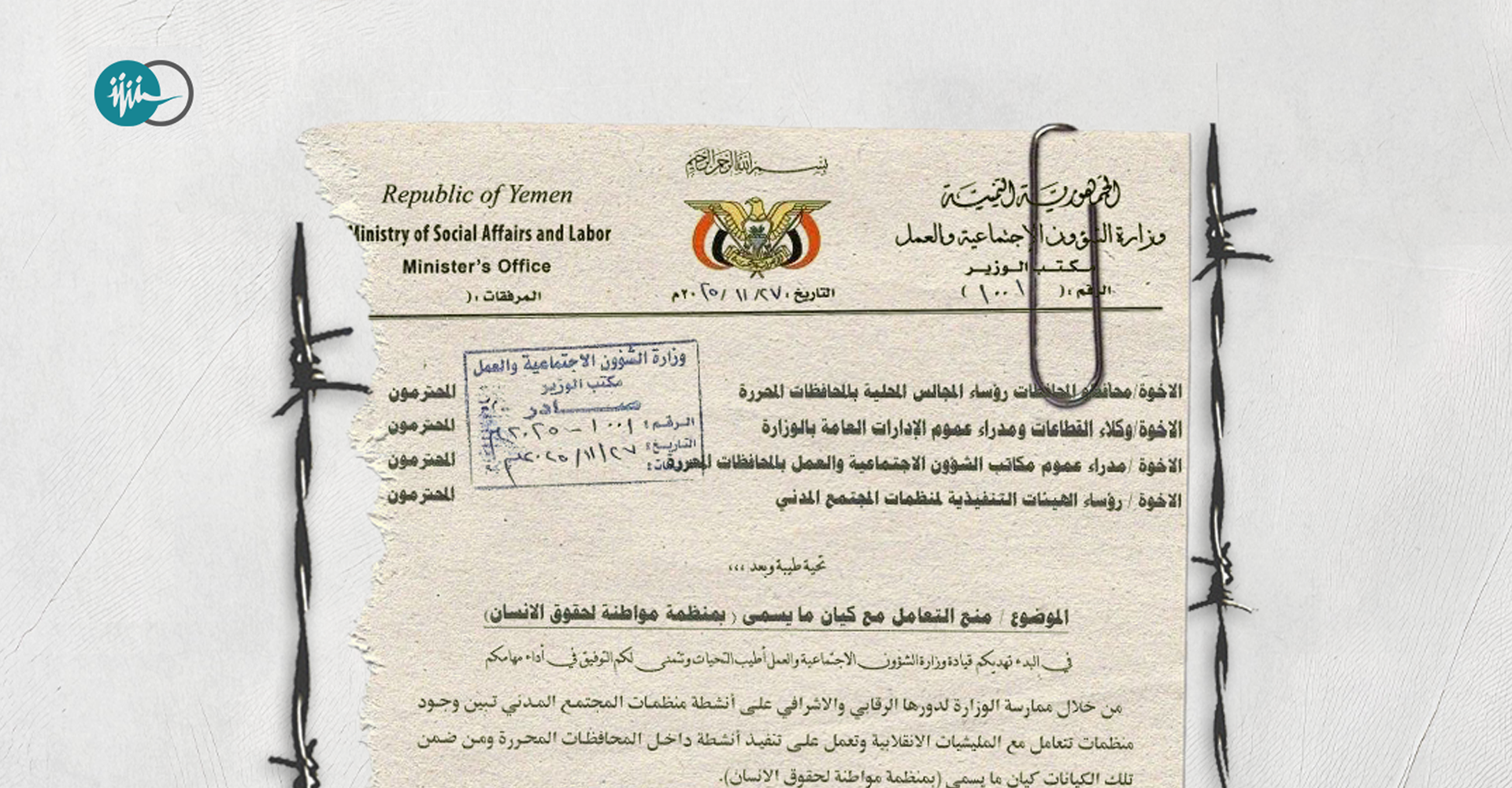
Mwatana for Human Rights stated that the memorandum issued by the Ministry of Social Affairs and Labor of the internationally recognized government on 27 November 2025, which prohibits engagement with Mwatana for Human Rights in areas controlled by several parties operating under the internationally recognized government and the Presidential Leadership Council, constitutes evidence revealing part of the violations and repressive measures perpetrated for years by the internationally recognized government and the Saudi/UAE-led coalition. These measures are acts of retaliation for Mwatana for Human Rights’ independent human rights work, in contravention of the Yemeni Constitution, the Law on Associations and Foundations, other national legislation in force, international conventions and covenants, and Yemen’s obligations and commitments before the international community.
The organization affirmed that these retaliatory and repressive actions taken by the internationally recognized government against Mwatana for Human Rights—actions that have no legal basis—will not deter it from fulfilling its duties. These duties include documenting and exposing human rights violations, providing legal support to victims, pursuing accountability, redress, and transitional justice, building capacities, raising awareness, and conducting advocacy, in accordance with the law, the constitution, and international instruments. This is despite the repeated violations the organization, its leadership, and its staff—women and men—have endured for years, including smear and incitement campaigns, defamation, intimidation and terrorization attempts, arbitrary detention and enforced disappearance, physical assaults, restrictions on freedom of movement and travel bans, multiple attempts at infiltration, suspension of activities, and direct and indirect threats and harassment, in addition to threats against partner organizations, institutions, and civil society actors, among other violations.
Radhya Al-Mutawakel, Chairperson of Mwatana for Human Rights, stated: “Throughout more than a decade of war in Yemen, attempts by warring parties to undermine the work of Mwatana have never ceased, as retaliation for exposing human rights violations committed by all parties and for supporting civilian victims. Targeted campaigns against the organization’s work escalated in an unprecedented manner during 2025, with the involvement of security and military entities in several areas, creating threats to the safety of the organization’s team. The circular issued by the Ministry of Social Affairs and Labor of the internationally recognized government against Mwatana—with its irresponsible and unrestrained implications—reflects a new level of targeting against the organization and its staff.”
Al-Mutawakel, added: “The memorandum issued by the internationally recognized government against Mwatana is based on a blatant attempt to use the designation of the Ansar Allah (Houthi) group as a Foreign Terrorist Organization by the United States government, and to accuse Mwatana of working in support of the group’s agenda as a pretext to target and undermine the organization. This allegation is irresponsible and exceedingly flimsy when weighed against the extensive body of reports, studies, positions, and interactive maps produced by Mwatana for Human Rights, which present a comprehensive depiction of violations committed by all parties without exception. These constitute the foundational reference for how Mwatana for Human Rights is defined inside and outside Yemen—standing in direct contrast to the abusive and malicious labels and classifications propagated by the parties.”
Mwatana for Human Rights affirmed that the unfounded and general claims cited in the Ministry’s memorandum as justification for its unlawful measures against the organization are clearly refuted by the extensive body of work the organization has accumulated over the years. This corpus of work provides definitive evidence that the organization maintains equal distance from all parties and documents violations committed by all sides to the conflict without exception. These include the Ansar Allah (Houthi) group, the Saudi/UAE-led coalition, the internationally recognized government, the Southern Transitional Council, the Joint Forces, formations affiliated with the Islah Party, terrorist organizations, as well as violations committed by the United States, the United Kingdom, Israel, and any other actors. The organization further stressed that it works alongside civilian victims and their families across all regions of Yemen with independence and objectivity. It also provides legal assistance to victims before various authorities through unified mechanisms and a transparent and standardized methodology. Mwatana operates in areas controlled by different parties alongside dozens of UN agencies and offices, and independent international and local organizations and institutions working with victims in conflict areas regardless of the identity of the controlling authority—an entirely normal practice that had never before been used as a pretext for targeting or condemning these entities or labeling them, until the Ministry of Social Affairs and Labor in Aden ventured to do so in its memorandum against Mwatana.
Mwatana for Human Rights stated that all of the organization’s activities are carried out in accordance with national legislation and international covenants, and in line with best practices. The organization adheres across all its operations to the principles of transparency, neutrality, accuracy, independence, inclusiveness, and institutional integrity. All of its activities are public and widely witnessed, involving thousands of Yemenis—women and men—from all backgrounds across different areas of Yemen and abroad, all of whom are fully aware of the organization’s work. These activities align with the organization’s purpose and objectives and match what it publishes on its website, its social media accounts and pages, and its interactive maps, which transparently and comprehensively present the outputs of its field-based investigative work. This is in addition to its written, visual, and audio publications, including statements and briefings, positions and commentaries, reports, studies, research papers, documentary films, and other human rights outputs, all of which focus on civilian victims, their protection, and the values of human rights, freedoms, justice, the rule of law, accountability, redress, transitional justice, and peace—values that do not align with the agenda of any party involved in the conflict.
Contrary to the misleading allegations contained in the memorandum of the Ministry of Social Affairs and Labor of the internationally recognized government—that Mwatana for Human Rights is unregistered and unlawful—the organization affirmed that it holds valid legal registration in the capital, Sana’a, renewed annually since it was first issued in April 2013, following six full years of unlawful obstruction by the Saleh regime. The organization also holds legal registration issued by the Ministry of Social Affairs and Labor in Aden, which had likewise been renewed annually. In 2023, at the time of the annual renewal, Mwatana submitted all required documents and paperwork for renewal to the ministry in Aden and complied with all subsequent requests until the file was completed and forwarded to the Minister of Social Affairs. Despite months of continuous follow-up with the ministry in Aden, Mwatana for Human Rights never received any written and substantiated refusal to renew its work permit, in accordance with Article (10) of the Law on Associations and Foundations No. (1) of 2001. Article (9) of the same law stipulates that “the ministry or its relevant office must decide on the application within one month from the date of its receipt. If this period lapses without a decision being issued, the application shall be considered approved by force of law. The ministry or its relevant office must, upon request by the concerned party, proceed with registering the organization in the official registry and publishing the approval in one of the official newspapers.”
Mwatana for Human Rights stated that the actions taken by the Ministry of Social Affairs and Labor in Aden against the organization, including its memorandum, violate the Law on Associations and Foundations, whose Article 3 stipulates that the law aims to:
“Provide the necessary guarantees to ensure that associations and foundations can carry out their activities with complete freedom and independence, in a manner consistent with their social responsibilities, and to simplify procedures and facilitate processes related to the right to establish associations and foundations, enabling them to fulfill their mission to the fullest extent.”
The content of the memorandum, along with the internationally recognized government’s broader repressive and retaliatory practices against Mwatana for Human Rights, places the government in clear violation of its international obligations, given that Yemen is a State Party to the International Covenant on Civil and Political Rights (ICCPR). The memorandum violates Articles 19, 22, and 26 of the ICCPR.
While Mwatana for Human Rights reaffirmed that the organization reserves all legal rights in responding to the internationally recognized government’s unlawful and retaliatory measures against it, the organization emphasized the importance of the role of local civil society in defending the rule of law and confronting campaigns of repression and intimidation. The organization also underscored the importance of regional and international organizations supporting local organizations, publicly rejecting any violations targeting their work, and contributing to their protection.
Mwatana for Human Rights called on the international community to fulfill its responsibility by clearly expressing its rejection of the repressive measures taken against the organization, and by pressuring the Presidential Leadership Council, the internationally recognized government, and the Southern Transitional Council to halt all unlawful retaliatory actions targeting the organization, lift all restrictions that undermine the freedom and independence of civil society organizations, and adhere to national laws and regulations.
Why is Mwatana Being Targeted?
Mwatana for Human Rights is being targeted because of its ongoing work documenting violations committed by all parties in Yemen and its active role in shedding light on the harm suffered by civilian victims.
Between 2014 and 2025, Mwatana documented no fewer than 18,200 incidents of violations by various parties and issued 35 human rights reports, including eight annual reports. It has also produced eight in-depth studies, dozens of human rights films, statements, blogs, and other human rights publications, in addition to conducting international advocacy missions, pursuing accountability and redress, providing legal support to victims, and undertaking capacity building and awareness efforts.
To learn more about the work of Mwatana for Human Rights, you may visit the organization’s website:
You may also explore the interactive map of human rights violations at: