From an export platform and pillar of the national economy to underground detention cells
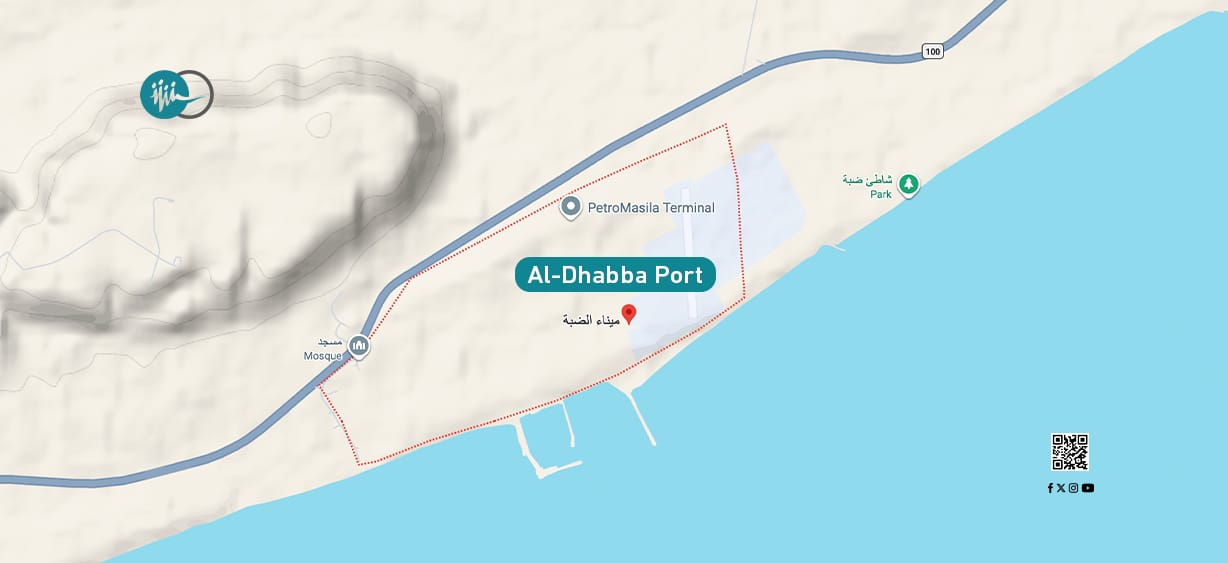
On the eastern coast of the city of Mukalla, where the Arabian Sea meets the Hadramawt plateau, lies the Al-Dhabba oil port. It is a facility established to serve as the country’s economic gateway and a conduit for oil exports, and one of Yemen’s most prominent sovereign installations. Since its inauguration in the early 1990s, the port has been associated with the idea of the national economy, as a civilian facility presumed to enjoy special safeguards—not to become a space of fear or deprivation of liberty.
Yet this place, designed to receive massive oil tankers and store millions of barrels, has been transformed into unofficial detention basements where civilians have been held outside the framework of the law and subjected to enforced disappearance and ill-treatment, far from any judicial oversight or clear legal process, under the direct supervision of the Saudi/UAE-led Coalition.
Al-Dhabba Port extends over a vast area surrounded by military and security complexes established to protect oil facilities. With the security transformations witnessed along the Hadramawt coast since 2016, strict control was imposed over the port and its surroundings, and wide areas were closed off to civilians. Within these isolated spaces, and beyond the reach of the judiciary, documented testimonies collected by Mwatana indicate that facilities affiliated with the military complexes surrounding the port’s perimeter were used as unofficial detention centers, established without publicly declared legal decisions and not subject to any judicial oversight.
Mwatana for Human Rights documented the detention of at least 11 victims at the unofficial detention center in “Al-Dhabba,” including five victims who were subjected to multiple forms of physical and psychological torture. Mwatana also documented six cases of enforced disappearance for extended periods.
According to Mwatana’s documentation, detainees in these centers were not held pursuant to judicial orders, were not presented before the Public Prosecution, and were not allowed to communicate with their families or appoint lawyers. Some disappeared for weeks or months without their families knowing their whereabouts, in a clear pattern of enforced disappearance.
One victim interviewed by Mwatana’s team recounted his experience inside the facility. He stated that he was held in solitary confinement within Al-Dhabba camp for 48 days, spending most of that time in complete isolation from the outside world. He described the cell as narrow, measuring no more than three by three meters, with minimal lighting, ventilation, and a small bathroom barely usable.
His interrogation began one day after his detention, and the sessions lasted for long hours. During those sessions, he was repeatedly beaten, subjected to electric shocks, and continuously threatened. He said the pain was not only physical but also psychological, as the aim was to break his will and extract confessions regarding allegations he did not even understand. He recalled being suspended in chains by his hands and feet for extended periods, before being left shackled inside the cell for consecutive days, including during trips to relieve himself. He said that time inside the cell lost its meaning, and that the fear was not only of the beatings but of the unknown, and of the idea that no one outside knew of his existence.
In another testimony, Mwatana documented the account of the father of a young man detained at the same site. The father stated that his son suddenly disappeared without any official notification, and that the family did not know his whereabouts for two full months. During that period, the family lived in a state of constant anxiety, with no information about their son’s fate. When they later learned of his place of detention, he had already endured a harsh experience inside the camp.
According to the father’s account relayed from his son, the latter was held in solitary confinement inside a small caravan, and repeatedly taken to interrogation rooms within the camp. During interrogation sessions, he was beaten with hands and feet, flogged with a whip, subjected to waterboarding, and given electric shocks, in addition to threats of death if he did not confess to the accusations against him. The father reported that his son was forced to sign and fingerprint documents he was not allowed to read, and that the marks of torture remained visible on his body for many days thereafter. For the father, the physical wounds were not the only source of pain, but also the realization that his son had been detained outside any legal protection and beyond the reach of any authority to which they could turn.
Mwatana for Human Rights affirms that what it documented in the vicinity of Al-Dhabba Port constitutes a grave violation of Yemeni law. The port is a civilian economic facility, and converting any part of it or its surroundings into a detention center constitutes a violation of applicable laws and legislation. Moreover, detaining civilians within military or security facilities not legally recognized, and depriving them of judicial oversight, constitutes a clear breach of the fundamental guarantees of a fair trial and places detainees in a state of ongoing risk.
Mwatana for Human Rights stresses that these incidents require an independent and serious investigation, the accountability of those responsible, and full reparation for victims, in a manner that ensures the non-recurrence of such violations, preserves the civilian character of civil facilities, and safeguards human dignity.