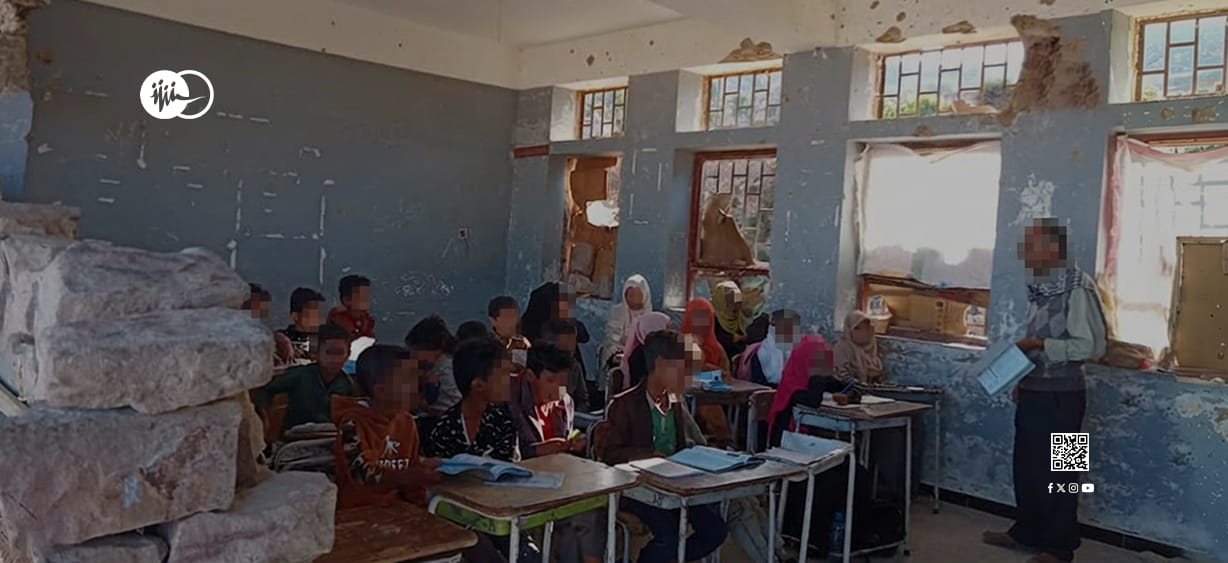
Ongoing Undermining and Generations at Risk
Mwatana for Human Rights stated, in a statement issued on the occasion of the International Day of Education, marked annually on 24 January, that the armed conflict ongoing in Yemen for more than a decade has led to the systematic and widespread undermining of the right to education. The education sector has become one of the most severely affected sectors, with various parties continuing to commit various types of violations against educational facilities even amid the suspension of military operations since the announcement of the nationwide truce on 2 April 2022.
Mwatana noted that the conflict and its direct and indirect repercussions have resulted in the total or partial destruction of educational facilities. The continued occupation of schools or their use for permanent or temporary military purposes has deprived thousands of children of their right to safe education, in the absence of adequate measures by the various parties to the conflict to protect and neutralize educational facilities.
Mwatana added that between September 2014 and the end of December 2025, it documented no fewer than 1,488 incidents of violations against schools. These included aerial and ground shelling, the bombing of schools, their occupation and use, as well as the exploitation of schools and educational facilities for mobilization and other military and political purposes. The Ansar Allah (Houthi) group bears responsibility for 1,144 incidents, the Saudi/UAE-led coalition for 164 incidents, the internationally recognized government and Islah Party-affiliated formations for 89 incidents, the Southern Transitional Council for 45 incidents, and the Joint Forces for 43 incidents of the total documented violations, in addition to three incidents attributed to terrorist organizations.
During 2025 alone, Mwatana documented at least 51 incidents of violations against schools. The Ansar Allah (Houthi) group was responsible for 46 incidents, while the internationally recognized Yemeni government and Islah Party-affiliated formations were responsible for four incidents, and the Southern Transitional Council for one incident against schools. These violations included the armed use of schools and educational facilities, whether in whole or in part, the use of schools for mobilization purposes, ground attacks, and other related violations.
Mwatana further stated that the use of schools for mobilization and recruitment, and the establishment of open and closed summer centers parallel to the formal education system by the Ansar Allah (Houthi) group—through which children are trained in combat skills—along with other related violations, have contributed to depriving millions of Yemeni children of access to safe and continuous education. These practices have turned educational facilities into arenas of conflict, in flagrant violation of the right to education.
Radhiya Al-Mutawakel, Chairperson of Mwatana for Human Rights, stated that “the damage inflicted on education in Yemen is directly linked to the continuation of the armed conflict and the failure of the parties to the conflict to protect civilians and civilian objects, foremost among them educational facilities.” Al-Mutawakel added, “the violations targeting schools and educational facilities across various regions over the years have contributed to increased dropout rates and child labor, preventing children from continuing their education in a safe environment.”
Al-Mutawakel further emphasized, “the ongoing violations against education and educational facilities—including the use of schools and educational institutions for military or political purposes—have catastrophic repercussions that extend to generations of Yemenis and are not limited to the current generation.” She stressed that “despite the decline in military operations during 2025, the targeting of schools and educational facilities by the parties to the conflict continues to pose a serious challenge to the right to safe and adequate education in Yemen.”
Mwatana emphasized that the statistics on violations affecting educational facilities in Yemen are far higher than what the organization has been able to document and access through its field team of female and male researchers across various governorates. Documentation is conducted through in-depth interviews with eyewitnesses and primary sources, obtained with their informed consent, and supported by the collection of numerous corroborating materials, including photographs, video footage, and other forms of evidence.
Examples of documented violations during 2025:
An eyewitness from the local community told Mwatana that clashes erupted near the school between the Fourth Mountain Infantry Brigade and defecting forces, escalating into an assault on the school and the brigade’s deployment inside it. As a result, the educational process was suspended, and students and teachers were unable to attend school. The incident was accompanied by indiscriminate gunfire in the village and the imposition of a siege on the area. The school remained in use by the Fourth Mountain Infantry Brigade until December 2025.
An eyewitness reported to Mwatana that, over the past years, local residents have repeatedly called for the evacuation of the school building by the forces stationed there, both through direct negotiations with those forces and by formally addressing the District Education Office and the Governorate Office of Education. Despite repeated promises to vacate the school, these commitments were never implemented in practice. The witness stressed that the local community is in urgent need of the school, given its capacity compared to the current alternative building, which consists of only two rooms used as a school. As a result, students from grades one to four are taught in two shifts during the academic terms. Meanwhile, fifth-grade students have been forced to relocate to study in an area far from Al-Badee’, requiring them to travel long distances daily, while female students were compelled to drop out of school due to their inability to commute or because their families refused to allow them to study outside the area.
A female eyewitness told Mwatana that she attended one of these events and that, upon its conclusion, the female students were in a state of extreme exhaustion and fatigue. She added that her daughter suffered from severe headaches after leaving the event due to sunstroke, noting that such incidents frequently recur during similar activities. She explained that the large number of events places significant strain on students and teachers alike, in addition to wasting a substantial number of class periods. She also noted that preparations for these events take nearly a month and involve repeated activities that bear no relation to students’ education or academic needs.
Mwatana further stated that parties to the conflict in Yemen continue to use some schools and educational facilities for various military and security purposes on a recurrent basis over many years, constituting a grave violation of the principle of protecting civilian objects and ensuring the neutrality of the educational process. Schools have been converted into military barracks, detention centers, or positions for deployment and gunfire, resulting in the disruption of education and the deprivation of children of their right to attend school.
Examples of the Continued Use of Schools for Military Purposes
An eyewitness told Mwatana—himself a former student at Mohammed Ali Othman School—that at the start of the war, the Ansar Allah (Houthi) group seized control of the area and began using the school as a military barracks. He added that the school was later subjected to shelling by forces of the internationally recognized government and the Abu Al-Abbas Brigades using tanks and heavy weapons, and that the Ansar Allah group also planted landmines inside the school. He explained that the shelling coinciding with the explosions of the mines led to the widespread destruction of the school buildings, rendering them unfit for use even if Ansar Allah fighters were to withdraw.
He added, “This is the greatest catastrophe, because the war deprived Taiz of Mohammed Ali Othman School and of advanced education and higher-level learning it once provided, denying students the opportunity to learn under qualified teachers.”
An eyewitness told Mwatana that Al-Jeel School in the Al-Awshaqi area had been used for military purposes by the Ansar Allah (Houthi) group from 2015 to 2018, during which time it served as a prison and supply center. He added that in 2018 the school came under the control of the Giants Brigades, and that since 2022 control has been held by the Joint Forces. He explained that an attempt was made to resume the educational process at the school during the previous year after the Joint Forces agreed to remain outside the school premises during school hours and return to stay there overnight. However, on the first day of classes, while students were present, a mortar shell landed near the school, fired from Ansar Allah positions on Jabal Al-Barhain overlooking the school. In consultation with the school administration and parents, a decision was taken to temporarily suspend classes due to the direct threat to children’s safety. He stressed that the continuation of education remains impossible as long as this danger persists.
Mwatana had previously documented, in a field study entitled “War of Ignorance: The Various Impacts of the Armed Conflict in Yemen Since Its Outbreak in September 2014,” the devastating effects of the conflict on the public education sector, as one of the most vital sectors undermined by the war. In its report “Undermining the Future,” Mwatana also documented attacks and assaults on schools and educational facilities in Yemen between March 2015 and December 2019. In addition, it produced the documentary “Chalk Dust,” which examines the impact of the armed conflict on education in Yemen, presenting testimonies from students, teachers, and parents, and shedding light on school dropout rates, child recruitment, and the risks arising from armed clashes and deteriorating security conditions.
The right to education is a fundamental right guaranteed under various international legal instruments. The Universal Declaration of Human Rights affirms that everyone has the right to education; that education shall be free, at least at the elementary and fundamental stages; that elementary education shall be compulsory; and that technical and vocational education shall be generally available. The Convention on the Rights of the Child, to which Yemen is a State Party, also affirms States’ obligations to ensure and protect children’s right to education during armed conflict.
The Safe Schools Declaration, a governmental political commitment endorsed by the United Nations, calls for the protection of students, teachers, and educational facilities, for limiting the military use of schools and universities, and urges States and parties to conflict to adopt concrete measures to ensure the continuity of education, respect the civilian character of educational institutions, and refrain from turning them into military objectives or sites.
According to the 1999 United Nations Security Council resolution on children and armed conflict, which condemns and identifies six grave violations against children during times of conflict and war, attacks on schools constitute one of these six grave violations.
Mwatana stated that protecting education in Yemen constitutes a legal obligation that must not be compromised, and that ensuring children’s access to safe and quality education is a fundamental prerequisite for safeguarding their basic rights and strengthening prospects for the long-awaited peace. It stressed the necessity for all parties to the conflict to cease violations against education and educational facilities and to take urgent measures to ensure respect for the right to education without discrimination, placing the best interests of children at the center of any future efforts.
Mwatana for Human Rights called on all parties to the conflict to immediately halt all violations affecting education and educational facilities, including the military use of schools, the political instrumentalization of educational institutions, and other practices prohibited under international law.
It further demanded guarantees for children’s right to access safe and appropriate education in all areas, the adoption of effective measures to reintegrate out-of-school children into the education system, the provision of the necessary requirements to enable their enrollment in schools, and serious, responsible action to clear and remove landmines and remnants of war from the surroundings of educational facilities and the roads leading to them, as well as the rehabilitation of damaged schools.
Mwatana for Human Rights renewed its call on the international community, including the United Nations and influential States, to support efforts aimed at achieving peace in Yemen, and to work toward the establishment of an independent international mechanism of a criminal nature to investigate human rights violations committed in Yemen, including violations affecting education and educational facilities, and to collect and preserve relevant evidence, in order to ensure accountability for those responsible for these violations and to contribute to the realization of a just and sustainable peace.