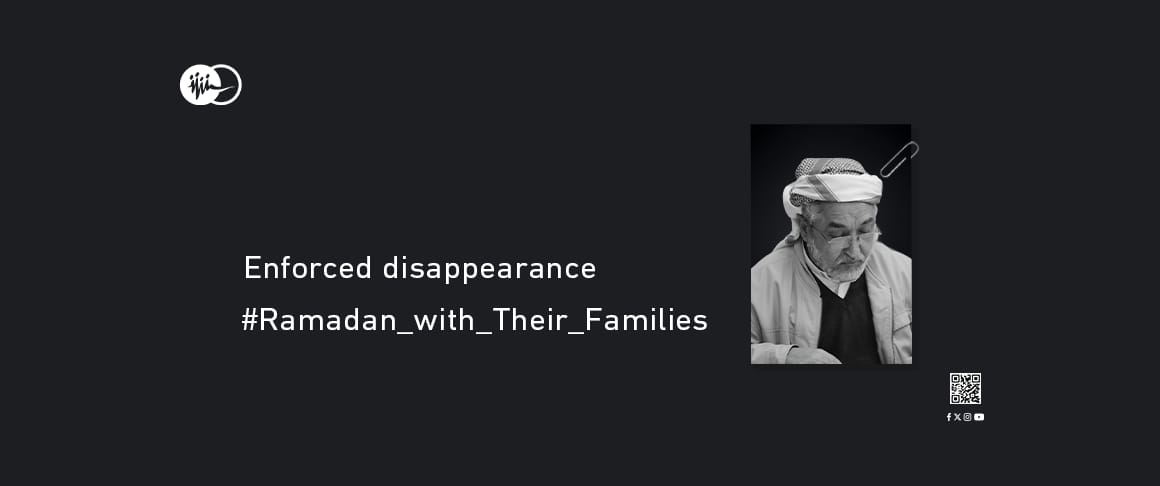
An Extended Narrative of Absence Exceeding a Full Decade
In the midst of the turbulent political transformations witnessed in Yemen since the takeover of the capital Sana'a by the Ansar Allah Armed Group (Houthis) in September 2014, a path emerged that led to the disappearance of one of the most prominent political figures in the country, Mohammad Qahtan, one of the leaders in the Yemeni Islah Party and a member of its Supreme Committee.
In February 2015, armed members of the Ansar Allah armed group (Houthis) detained Mohammad Qahtan at a checkpoint in Ibb Governorate while he was heading to Taiz. His detention was not officially announced; instead, he was returned to his home in Sana'a and placed under house arrest. He remained confined in his home under undisclosed restrictions, without a judicial warrant or clear legal process, until April 4, 2015.
Around 1 PM on that day, an armed force arrived at his home in the Al-Nahda neighborhood of Sana'a. They were driving civilian vehicles and wore military uniforms. Some family members attempted to prevent them from entering, but they insisted on taking him. The family was informed that he would be taken with them, without presenting an arrest warrant or a statement indicating the authority or reason for his detention. He requested to perform the noon prayer before leaving, but the force did not allow him that time, and he was taken immediately from his home.
He was first transferred to the home of Lieutenant General Ali Mohsen Al-Ahmar, which had been seized by the Ansar Allah group (Houthis) and turned into a detention site, and was later moved to the home of leader Hamid Al-Ahmar, also used as a detention site. Neither of these locations was an official detention center subject to recognized legal procedures.
In the initial days, only one visit was allowed for one of his sons, which came after mediations. That visit was the last confirmed evidence of his being alive. Following this, the family was prohibited from any further communication; no additional visits were permitted, nor did any official body provide information regarding his whereabouts or health status.
Months turned into years without an official announcement revealing his fate, leading to nearly eleven years of enforced disappearance, completely cut off from his family and the outside world.
Throughout these years, the family has not received any legal notification confirming his detention, nor has he been allowed regular communication with his relatives. This pattern of deprivation of liberty, coupled with the denial of knowledge of his fate or location of detention, falls under the definition of enforced disappearance in international law, as stated in the International Convention for the Protection of All Persons from Enforced Disappearance. The Rome Statute, adopted by the International Criminal Court, classifies it as a crime against humanity when committed in the context of a widespread or systematic attack.
The case of Mohammad Qahtan is no longer just a matter of political arrest; it has transformed into an extended absence exceeding a full decade, without official information or clear legal process. While the conflict in Yemen continues, this case remains one of the most prominent and prolonged instances of enforced disappearance associated with the events following 2014, and his fate remains unknown to this day.
The International Convention for the Protection of All Persons from Enforced Disappearance, as well as the United Nations Declaration on the Protection of All Persons from Enforced Disappearance, confirms that no exceptional circumstances may be invoked to justify this crime, whether related to a state of war, a threat thereof, internal political instability, or any state of emergency or exception.
The Ansar Allah group (Houthis) must immediately disclose the fate of Mohammad Qahtan and all individuals who are forcibly disappeared in their custody, release all arbitrarily detained persons, adhere to the applicable national legislation and relevant international laws, hold accountable those responsible for these violations, and provide redress for the victims and their families.