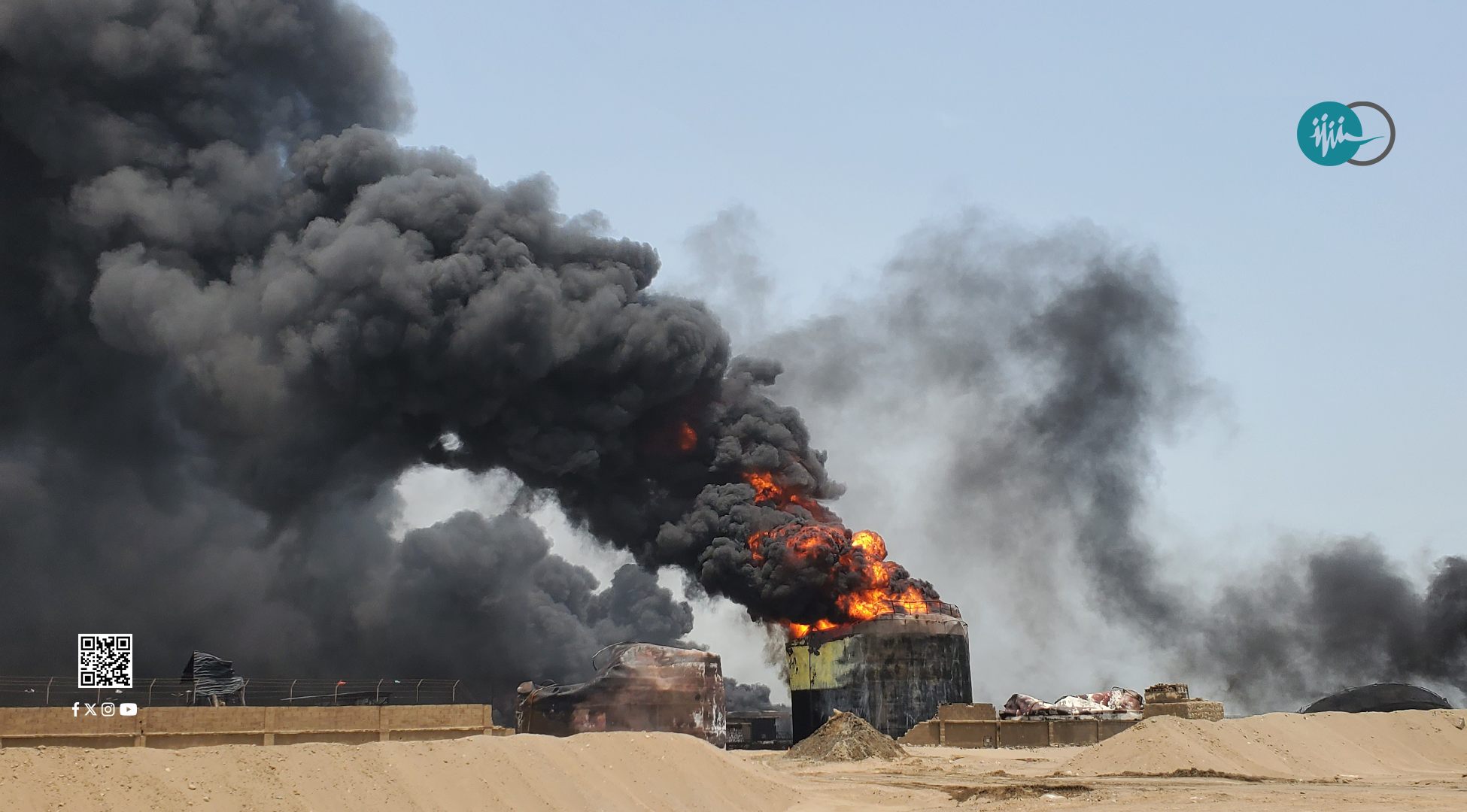
Israeli Warplanes Strike Yemen’s Vital Al Hudaydah Port for the Eighth Time
Mwatana for Human Rights reported that Israeli warplanes have attacked Yemen’s vital Al Hudaydah port for the eighth time within a year. Around 11:30 p.m. on Sunday, July 6, 2025, Israeli warplanes carried out no fewer than fifteen airstrikes targeting the container and grain terminals at Al Hudaydah Port, in northwestern Yemen. Additionally, Ras Issa Port was struck by approximately ten airstrikes targeting fuel discharge terminals (for gasoline and diesel), while As-Salif Port was subjected to around seven airstrikes hitting its docks. The power station in As-Salif was also bombed with approximately six airstrikes that struck generation units and boilers. Israel declared that these attacks were in retaliation for the Ansar Allah (Houthi) group’s operations targeting Israel-linked shipping in the Red Sea and sites inside Israel, including rocket attacks on Ben Gurion Airport—actions that the group claims are in solidarity with the Palestinian people in the Gaza Strip.
Al Hudaydah Port represents the sole lifeline for millions of people living in areas under the control of the Ansar Allah (Houthi) group in Yemen. More than 80% of humanitarian aid, commercial imports, and essential goods—including food, fuel, and medical supplies—enter Yemen through this port. Over 28 million Yemenis rely on these imports for survival. For nearly a decade of conflict, shipments to Al Hudaydah have undergone rigorous and comprehensive inspections through the United Nations Verification and Inspection Mechanism (UNVIM).
Mwatana for Human Rights stated that the Israeli attacks on Al Hudaydah Port and other civilian infrastructure in the city constitute a war crime, violating the protections afforded by international humanitarian law (IHL) to civilian facilities and infrastructure. These attacks breach key IHL principles, including proportionality, protection, and distinction, and undermine the protections granted to civilian objects under Article 54 of Additional Protocol I to the 1977 Geneva Conventions, which prohibits “the deliberate restriction or obstruction of supplies essential for the survival of the civilian population, or the deliberate destruction of agricultural areas, crops, livestock, water installations, and irrigation works necessary for civilian survival.” The attacks also violate Article 147 of the Fourth Geneva Convention, which considers “extensive destruction and appropriation of property, not justified by military necessity and carried out unlawfully and wantonly,” as grave breaches and criminal acts.
According to Article 8(2)(a)(iv) of the Rome Statute of the International Criminal Court, “extensive destruction and appropriation of property, not justified by military necessity and carried out unlawfully and wantonly,” constitutes a grave war crime. Additionally, Article 8(2)(b) identifies as serious violations of the laws and customs applicable in international armed conflicts:
• Intentionally directing attacks against civilian objects, that is, objects which are not military objectives;
• Intentionally launching an attack in the knowledge that such attack will cause incidental loss of life or injury to civilians or damage to civilian objects or widespread, long-term, and severe damage to the natural environment which would be clearly excessive in relation to the concrete and direct overall military advantage anticipated;
• Attacking or bombarding, by whatever means, towns, villages, dwellings, or buildings which are undefended and which are not military objectives;
• Intentionally directing attacks against buildings, material, medical units and transport, and personnel using the distinctive emblems of the Geneva Conventions in conformity with international law; and
• Intentionally using starvation of civilians as a method of warfare by depriving them of objects indispensable to their survival, including willfully impeding relief supplies as provided for under the Geneva Conventions.
All of the above constitute serious violations of international humanitarian law governing armed conflicts.