
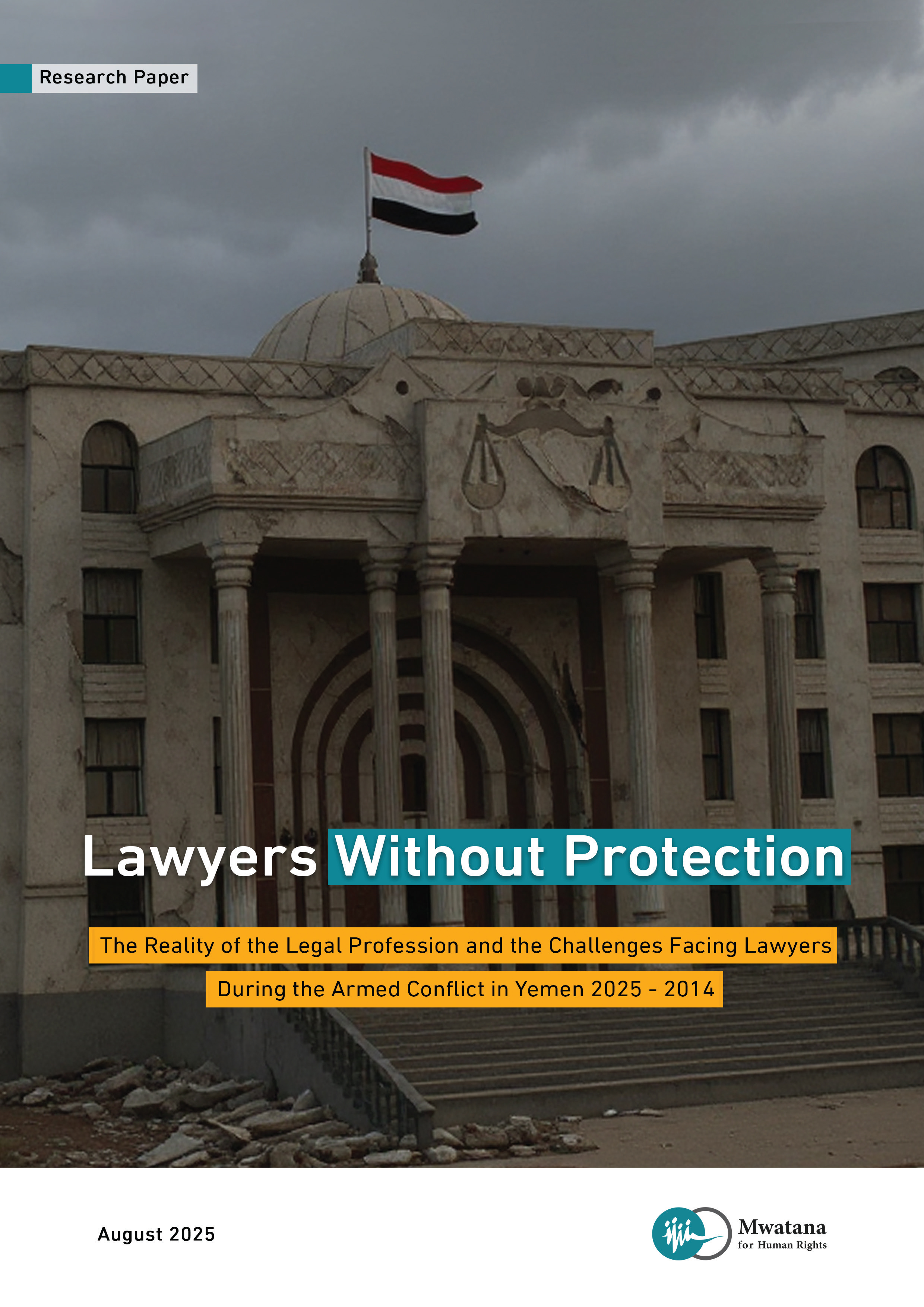

Mwatana for Human Rights, in a statement announcing the release of its research paper “Lawyers Without Protection”—which examines the state of the legal profession and the challenges faced by lawyers during the armed conflict in Yemen—stated that the legal profession, a fundamental pillar of any country’s justice system and the rule of law, has faced mounting challenges and risks since the outbreak of the conflict in Yemen. The organization noted that the various parties to the conflict have denied the vast majority of detainees access to legal counsel during the evidence-gathering phase before judicial investigation authorities. Lawyers, meanwhile, face severe obstacles and impediments at all stages of criminal proceedings, which collectively undermine individuals’ right to legal defense—an essential requirement for a fair trial—under all circumstances.
Mwatana called on the judicial authorities in Sana’a and Aden to implement comprehensive reforms of the criminal courts to ensure trials that guarantee the right to legal defense and comply with fair trial requirements. It further urged comprehensive reforms of criminal prosecution offices to strengthen their full independence and their ability to exercise legal authority over all detention facilities run by various security agencies, including intelligence services, to ensure that investigations into detainees are conducted independently, with the right to legal defense guaranteed at all times. Mwatana also stressed that all places of detention, without exception, must be placed under the full authority and supervision of the Public Prosecution and the judiciary.
Radhya Al-Mutawakel, Chairperson of Mwatana for Human Rights, stated:
“A fair trial cannot be guaranteed without enabling individuals to fully exercise their inherent right to legal defense. This right cannot be assured without safeguarding the independence of the legal profession as a fundamental component of the justice system and the rule of law, and without ensuring that lawyers, both women and men, are able to fulfill their roles under all circumstances.”
She added:
“All parties must lift restrictions that undermine the independence of the legal profession, cease all practices and violations targeting lawyers, and compel all security agencies, including intelligence services, to guarantee the right to legal defense during the evidence-gathering phase under all circumstances, while prohibiting all forms of harassment and mistreatment, particularly those targeting female lawyers.”
The research paper found that during the post-detention and investigation phases, law enforcement agencies often deprive detainees in criminal cases of the right to legal counsel of their own choosing, or prevent lawyers from fully exercising their right to defend their clients in cases where some detainees manage to secure legal representation. In some instances, these agencies even resort to threatening lawyers with repercussions, citing the “security sensitivity” of the cases they are working on.
Mwatana’s paper, “Lawyers Without Protection,” further emphasized that lawyers’ role in defending their clients during investigations is also hindered by multiple procedural obstacles. Chief among these is the reluctance of higher levels of adjudication (prosecution and criminal courts) to correct earlier procedural violations that undermine defendants’ rights. Instead, these bodies often legitimize the unlawful practices of investigative and evidence-gathering authorities, using them as the basis for charges. This results in procedural violations being perpetuated across all judicial levels, becoming entrenched to the point of posing a serious threat to justice—one that lawyers struggle to challenge or reverse in later stages of litigation.
Additionally, lawyers’ motions and requests submitted during investigations and trials are often rejected without legal justification, or ignored altogether. This strips lawyers of their legitimate legal tools to defend their clients. When such practices become systemic—as suggested by the cases studied—they erode clients’ confidence in the very purpose of the legal profession and foster a wider crisis of trust in society.
The paper employed qualitative analysis of relevant national and international legal texts governing the legal profession, the guarantees of its independence, and the rules regulating its practice. In its examination of the actual role of lawyers in defending their clients’ rights—and the violations and procedural breaches they face in criminal cases—the study drew on field interviews collected from centers in several governorates under the control of different parties to the conflict. These interviews included lawyers, clients who are victims or relatives of victims, bar members, criminal prosecutors, and criminal court judges.
The paper reached a set of conclusions on the legislative, procedural, and institutional challenges that impede lawyers’ work, along with the reforms needed to address them. These conclusions were based on the lived experiences of lawyers, their clients, prosecutors, judges, and bar members, and on international standards regulating the legal profession.
“Lawyers Without Protection”—which examines the obstacles facing male and female lawyers, and the requirements for strengthening and safeguarding their role—is part of a series of studies, research papers, and reports issued by Mwatana for Human Rights. The series aims to provide an accurate understanding of the state of human rights, rule of law, justice, and peace in Yemen, and to develop informed visions that can contribute to implementing an effective post-conflict transitional justice process.


